LCD vs OLED Screen Repair: What's the Difference?
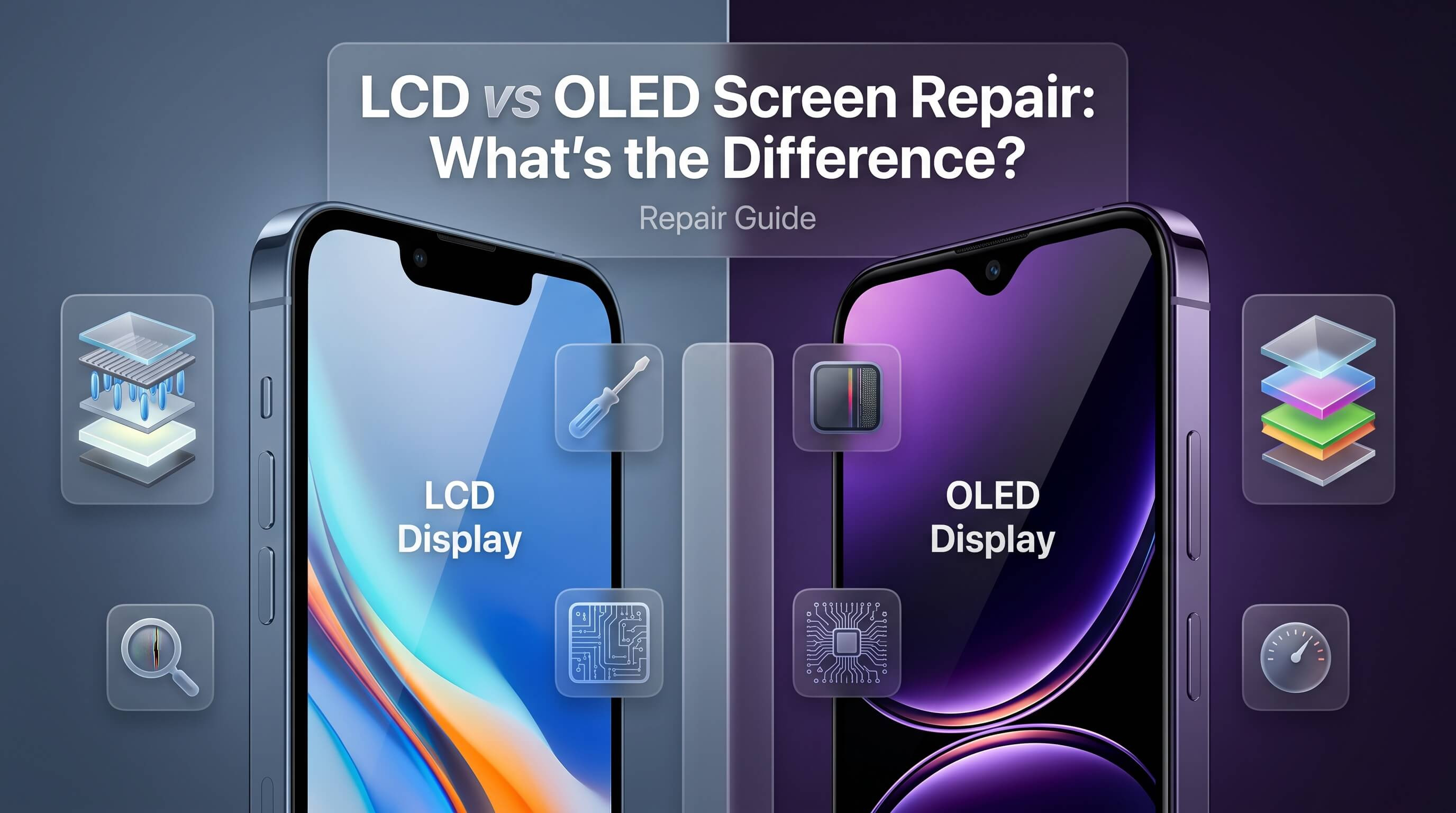
A cracked or malfunctioning phone screen is one of the most common repair requests any technician sees, yet the repair process behind the scenes looks very different depending on the display technology inside the device. LCD vs OLED screen repair is not a one-size-fits-all conversation. The materials, the tools, the failure patterns, and even the price tag can shift dramatically depending on which type of display sits behind that glass. Understanding lcd vs oled repair before booking a service appointment helps device owners set realistic expectations, avoid overpaying, and choose the right repair path for their specific phone or tablet.
This guide walks through the technical differences between these two display types, explains how damage manifests differently on each, and breaks down exactly what a repair technician does when replacing an lcd vs oled screen. Whether the goal is fixing a cracked iPhone display, replacing a shattered Samsung panel, or simply understanding the fine print before agreeing to a smartphone screen replacement, this article covers what matters most.
What Is an LCD Screen and How Does It Work
LCD stands for liquid crystal display, a technology that has been the backbone of phone and computer screens for decades. An LCD panel works by shining a constant backlight through a layer of liquid crystals, which twist and untwist to control how much light passes through each pixel. A color filter layer then determines the specific hue displayed at each point on the screen.
Because LCD panels rely on a separate backlight source, the entire screen illuminates uniformly, even in areas showing pure black. This is one of the defining characteristics of lcd display repair discussions: LCD screens cannot achieve true black, since the backlight is always on behind the liquid crystal layer, even when a pixel is instructed to display black. Instead, the crystals block as much light as possible, resulting in a dark gray rather than true black.
LCD technology has remained popular in many mid-range and budget smartphones because it tends to be less expensive to manufacture and, in many cases, less expensive to repair. The layered construction, however, means an LCD panel is generally thicker than its OLED counterpart, and it consists of multiple distinct components, including the backlight unit, the liquid crystal layer, the color filter, and the polarizers, all bonded together.
When damage occurs, LCD screens tend to show a very recognizable failure pattern. A cracked LCD panel typically develops dark blotches, colored streaks, or an area of the screen that stops responding to touch while the surrounding display continues functioning. In more severe cases, the entire backlight can fail, leaving the phone technically powered on but displaying nothing at all, since the liquid crystal layer has no light source to filter.
What Is an OLED Screen and How Does It Work
OLED, short for organic light-emitting diode, takes a fundamentally different approach. Rather than relying on a separate backlight, each individual pixel in an OLED display generates its own light. When a pixel is instructed to show black, it simply turns off completely, producing true, deep black levels that LCD technology cannot replicate.
This self-illuminating pixel structure is why oled screen repair discussions often mention richer colors, higher contrast ratios, and thinner overall panel construction. Because there is no backlight layer to accommodate, OLED panels can be built noticeably thinner and, in many cases, lighter than comparable LCD panels, which is part of why manufacturers have shifted toward OLED for flagship devices over the past several years.
Samsung's Super AMOLED technology, found across most modern Galaxy devices, is a specific and widely used variant of OLED. Super amoled screen replacement procedures share the same fundamental principles as general oled display repair, though the exact panel construction and calibration process can differ slightly between manufacturers. Apple has also adopted OLED panels across its more recent lineup, meaning most modern iPhone repair requests for display damage now involve OLED technology branded as Super Retina XDR, which is, at its core, an OLED panel tuned to Apple's specific color and brightness standards. Meanwhile, most current Samsung repair requests for display issues involve Super AMOLED panels across the Galaxy lineup, following the same OLED principles described above.
The self-illuminating nature of OLED pixels introduces a different set of failure patterns compared to LCD. Physical damage to an OLED screen often produces localized dark spots, colored blotches, or areas where the display appears to bleed color, since damaged organic compounds within individual pixels can short out or degrade unevenly. OLED panels are also more prone to a phenomenon known as burn-in, where static images displayed for extended periods can leave a faint, permanent ghost image, something that simply does not happen with LCD technology because LCD pixels do not age based on the specific colors they display.
Key Differences Between LCD and OLED Displays
Understanding the difference between lcd and oled phone screens goes beyond simply knowing which one looks better. Several practical factors separate the two technologies, and each one has direct implications for repair complexity, cost, and long-term device performance.
Contrast and color reproduction represent the most visually obvious difference. OLED screens produce genuinely deeper blacks and more vivid colors because each pixel controls its own light output independently. LCD screens, constrained by their backlight, generally display slightly washed-out blacks and a marginally narrower color range, though modern LCD panels have improved significantly compared to older generations.
Power efficiency varies depending on what is being displayed. OLED screens consume very little power when displaying dark content, since black pixels are essentially switched off, but can consume more power than LCD when displaying bright, mostly white content, since every individual pixel needs to generate its own light at full brightness. LCD panels consume relatively consistent power regardless of the content shown, since the backlight remains on at a fixed intensity.
Physical construction and repairability differ in ways that matter significantly during a repair. LCD panels are generally more resistant to minor impacts because the layered structure, while thicker, provides a degree of shock absorption. OLED panels, being thinner and more delicate, can be more susceptible to pressure damage and cracking, though the same thinness also makes OLED-equipped devices lighter and slimmer overall.
Longevity presents a nuanced comparison. LCD panels do not suffer from burn-in and tend to maintain consistent brightness over their lifespan, but they are more prone to backlight degradation over many years of use. OLED panels can experience gradual color shifting and, in cases of heavy use with static content, burn-in, but manufacturers have made significant strides in recent years to minimize this through pixel-shifting technology and adaptive brightness controls.
| Feature | LCD Display | OLED Display |
|---|---|---|
| Light source | Separate backlight | Self-illuminating pixels |
| Black levels | Dark gray, not true black | True, deep black |
| Panel thickness | Thicker | Thinner |
| Power use (dark content) | Consistent, no savings | Lower power draw |
| Power use (bright content) | Consistent | Higher power draw |
| Burn-in risk | None | Possible with static images |
| Typical repair cost | Generally lower | Generally higher |
| Common in | Budget and mid-range phones | Flagship phones and tablets |
Common Signs That Indicate Screen Damage
Recognizing the early warning signs of display damage, regardless of the underlying technology, helps device owners act before a small issue becomes a larger and more expensive problem. Some symptoms overlap between LCD and OLED, while others are more specific to one technology.
Visible cracks in the glass are the most obvious sign, but cracked glass does not always mean the underlying display panel is damaged. On many phones, the glass and the display panel are separate layers, meaning a cracked screen with a fully functional display underneath is possible, particularly on devices where the manufacturer uses a separate protective glass layer bonded over the panel.
Discoloration or dark patches spreading from a point of impact are a strong indicator of panel-level damage rather than surface-level glass cracking. On LCD screens, this often appears as dark, ink-like blotches or streaks of color bleeding across the display. On OLED screens, similar damage tends to appear as localized dark spots or areas with a slight color tint that differs from the surrounding pixels.
Touch responsiveness issues, where certain areas of the screen fail to register taps or swipes, frequently accompany physical damage, since the digitizer layer responsible for detecting touch input sits very close to the display panel and is often damaged simultaneously during an impact.
Flickering, flashing, or lines running across the screen can indicate a loose connector, a damaged display cable, or, in more serious cases, panel failure. This symptom is worth addressing quickly, since continued use of a flickering display can sometimes accelerate further damage to the connector or the panel itself.
Dimming that will not respond to brightness settings, or a screen that appears unevenly lit, points toward backlight problems on LCD panels specifically, since a failing backlight unit cannot always maintain consistent brightness across the entire display.
LCD Screen Repair Process Explained
When a technician performs lcd screen repair, the process generally follows a consistent sequence, though the specific steps vary slightly depending on the device manufacturer and model.
The repair begins with a full diagnostic to confirm whether the issue lies with the glass, the digitizer, the LCD panel itself, or a combination of these layers. On many older or budget devices, the glass and LCD panel are fused together as a single assembly, meaning even a glass-only crack requires replacing the entire screen unit. On some devices, particularly certain tablets and older phone models, the glass can be separated and replaced independently of the LCD panel, which can reduce repair costs when only the surface glass is cracked.
Once the diagnostic confirms the LCD panel itself needs replacement, the technician powers down the device completely and begins disassembly, carefully removing the housing, disconnecting the battery to prevent electrical damage, and detaching the display connector from the logic board. Because LCD assemblies are generally less delicate than OLED panels, this process, while still requiring precision, typically carries a slightly lower risk of accidental damage during removal.
The replacement LCD panel is then connected, tested before final reassembly to confirm proper function, touch responsiveness, and color accuracy, and secured back into the housing with fresh adhesive. A final quality check, including testing brightness uniformity and touch sensitivity across the entire screen surface, ensures the repair meets a reliable standard before the device is returned to the customer.
OLED Screen Repair Process Explained
The oled display repair process follows a similar overall structure but requires additional care due to the more delicate nature of OLED panels and their integration with other device components.
Diagnostics for OLED repair often need to account for the possibility of a damaged touch layer even when the visible display appears intact, since many modern OLED-equipped devices integrate the fingerprint sensor and touch digitizer directly into the display assembly. This tighter integration means a technician must carefully assess whether the fingerprint sensor, if present, is also affected by the damage.
Disassembly requires extra caution, since OLED panels are thinner and more prone to bending damage during removal, particularly around the flex cable connectors. Many OLED assemblies also include integrated components such as the earpiece speaker or proximity sensor, meaning careful transfer of these small parts from the damaged panel to the replacement panel is sometimes necessary, especially on models where these components are not included with the replacement part.
Sourcing the replacement panel is a critical step that significantly affects repair quality. Can oled screens be repaired to the same standard as the original? The honest answer depends heavily on the quality of the replacement part used. Original or original-equivalent OLED panels preserve accurate color calibration, true black levels, and consistent brightness, while lower-quality aftermarket OLED panels can result in a display that looks noticeably different, with color temperature that skews too warm or too cool, reduced maximum brightness, or slightly less responsive touch input.
After installation, the technician tests true black reproduction, color accuracy across a range of test images, touch responsiveness across the full display, and integrated component function such as the fingerprint sensor, before final reassembly and a closing quality inspection.
LCD vs OLED Repair Cost Comparison
One of the most frequently asked questions among device owners facing a cracked screen is straightforward: is oled screen repair more expensive than lcd? In the vast majority of cases, yes, and understanding why helps explain the price difference rather than simply accepting it at face value.
OLED panels are more expensive to manufacture due to the organic compounds and more complex pixel structure involved, and this cost difference carries directly through to the replacement part price. Additionally, OLED panels are more frequently found on flagship devices, which tend to have pricier components across the board, including more advanced touch digitizers and integrated biometric sensors that add to the overall part cost.
The complexity of the repair itself also factors into the price. Because OLED assemblies on many modern phones integrate additional components, such as fingerprint sensors, and require more delicate handling during disassembly and reassembly, technicians often need to allocate more time and precision to complete the job correctly, which is reflected in labor costs.
| Factor | LCD Screen Repair | OLED Screen Repair |
|---|---|---|
| Part cost | Lower | Higher |
| Labor complexity | Moderate | Higher |
| Repair time | Typically faster | Slightly longer on integrated models |
| Common devices | Budget and mid-range phones | Flagship phones, foldables |
| Risk of collateral damage | Lower | Higher due to thin panel |
| Overall lcd vs oled repair cost | Generally more affordable | Generally higher |
It's worth noting that exact pricing depends heavily on the specific device model, the extent of the damage, and whether original or aftermarket parts are used. Rather than relying on generic estimates, getting an accurate lcd vs oled screen replacement cost requires a hands-on diagnostic from a qualified technician, since two phones with seemingly similar damage can require very different repair approaches depending on internal component layout.
Parts Quality: Original vs Aftermarket Screens
Regardless of whether a device uses LCD or OLED technology, the quality of the replacement part used during repair has a significant impact on the final result, and this is an area where cutting corners often becomes obvious quickly.
Original or manufacturer-grade parts are built to the exact specifications of the device, ensuring accurate color reproduction, correct brightness calibration, and full compatibility with features like True Tone or adaptive refresh rates on devices that support them. These parts typically carry a higher upfront cost but deliver a repair result that closely matches the phone's original factory display quality.
Aftermarket parts vary considerably in quality. Higher-grade aftermarket panels, sometimes referred to as premium aftermarket or incell displays for LCD-based repairs, can offer a reasonably close match to original quality at a more accessible price point. Lower-grade aftermarket panels, however, often show noticeable differences, including dimmer maximum brightness, less accurate colors, reduced touch sensitivity, and, in the case of aftermarket OLED panels specifically, a shorter overall lifespan before color shifting or dimming becomes apparent.
| Part Type | Color Accuracy | Brightness | Touch Sensitivity | Typical Lifespan | Relative Cost |
|---|---|---|---|---|---|
| Original OLED | Excellent | Full manufacturer spec | Excellent | Long | Highest |
| Premium aftermarket OLED | Good | Slightly reduced | Good | Moderate to long | Moderate to high |
| Standard aftermarket OLED | Fair | Noticeably reduced | Fair | Shorter | Lower |
| Original LCD | Very good | Full manufacturer spec | Excellent | Long | Moderate to high |
| Aftermarket LCD | Good | Slightly reduced | Good | Moderate | Lower |
A reputable repair provider will always be transparent about which type of part is being used and why, allowing device owners to weigh the tradeoff between cost and long-term display quality before committing to a repair.
DIY Screen Repair vs Professional Repair Services
Screen replacement kits are widely available online, and some device owners consider attempting a repair at home to save on labor costs. While this approach can work for individuals with steady hands, the right tools, and realistic expectations, it carries meaningful risks that are worth understanding before diving in.
Attempting a DIY smartphone screen repair typically requires precision tools, including specialized screwdrivers, suction cups, plastic prying tools, and often a heat source to soften the adhesive holding the original screen in place. Even with the right tools, the process of disconnecting delicate ribbon cables and reconnecting a new display carries real risk, particularly on OLED-equipped devices where the panel and connectors are especially fragile.
A cracked screen repair attempted without proper anti-static precautions can also risk damaging sensitive internal components, since modern smartphones pack densely arranged circuitry close to the display assembly. A single slip with a prying tool can sever a cable that controls far more than the display, sometimes affecting the battery connector, the antenna, or the earpiece speaker.
| Consideration | DIY Repair | Professional Repair |
|---|---|---|
| Tool requirements | Must purchase specialized tools | Technician already equipped |
| Risk of collateral damage | Higher, especially on OLED | Lower, trained handling |
| Warranty impact | Often voids manufacturer warranty either way | Reputable shops offer repair warranty |
| Time investment | Several hours, learning curve | Often same-day service |
| Part quality assurance | Depends on kit purchased | Verified sourcing |
| Best suited for | Older, lower-value devices | Flagship phones, OLED devices, warranty-conscious owners |
For older, lower-value devices where the financial risk of a mistake is minimal, a careful DIY repair using a quality replacement kit can be a reasonable option for experienced hobbyists. For flagship phones, OLED-equipped devices, or any situation where the owner wants a guaranteed, warrantied outcome, professional phone repair services remain the more reliable choice, particularly given how tightly integrated modern displays have become with other critical components.
When to Choose LCD Repair vs OLED Repair
The decision of lcd or oled which is better for phone repair is not really a matter of choosing one over the other, since the display technology is determined by the device itself rather than a preference selected during repair. However, understanding this distinction still matters when making decisions about repair versus replacement, and when comparing repair costs across different devices someone might be considering.
For someone deciding between repairing an older LCD-equipped device versus purchasing a newer OLED phone, it helps to weigh the lower repair cost of LCD panels against the visual and efficiency benefits OLED offers. A relatively minor lcd screen replacement on a functioning, otherwise healthy device is often the more economical choice compared to replacing the entire phone, especially when the device meets all other needs.
For OLED-equipped devices, the higher repair cost is generally still more affordable than replacing an entire flagship phone, particularly for devices less than two or three years old. The investment in a quality oled screen repair, using original or premium aftermarket parts, typically extends the useful life of the device significantly, making it a financially sound choice compared to purchasing a new device outright.
The Role of Screen Repair in Broader Device Health
A damaged screen rarely exists in complete isolation from the rest of the device, and a thorough phone display replacement often uncovers related issues worth addressing during the same repair visit. Impacts severe enough to crack a screen frequently also affect the battery connector, charging port alignment, or internal frame integrity.
Device owners bringing in a phone for broken display repair should feel comfortable asking their technician to check for related concerns, including battery health, since a battery replacement performed alongside a screen repair can save an additional visit down the line. Similarly, charging issues that were present before the screen damage occurred are worth mentioning during the diagnostic conversation, since impact damage can sometimes worsen a charging port that was already showing early signs of wear.
Beyond phones, the same LCD versus OLED considerations apply across a growing range of devices. Tablets, smartwatches, and even some gaming console repair scenarios involve similar display technology decisions, and laptop repair for screen issues follows comparable principles, since many modern laptops have also transitioned from LCD to OLED panels in their premium product lines. Understanding the fundamentals covered in this guide translates well across this broader range of devices, since the underlying display science remains consistent even as the specific repair procedures vary by device type.
Get Expert LCD and OLED Screen Repair Today
Living with a cracked or malfunctioning screen affects far more than appearance. It limits usability, increases the risk of further internal damage, and can even pose a safety concern if broken glass is present. Whether the device in question uses LCD or OLED technology, getting it properly assessed and repaired by an experienced technician ensures the fix is done right the first time, with parts and techniques matched to the specific display type.
Phone Repair Place provides skilled, reliable screen repair services for both LCD and OLED-equipped devices, backed by technicians who understand the technical nuances separating these two display technologies. From same-day walk-in service to fast, accurate diagnostics, the team is equipped to handle everything from a simple cracked screen repair to a full smartphone display replacement using quality parts that preserve the look and feel of the original device. Every repair is backed by a service warranty, giving customers confidence that their investment is protected well after they leave the shop.
Getting started is easy. Readers dealing with a cracked, flickering, or unresponsive screen can call ahead to schedule a diagnostic, stop by for a same-day walk-in appointment, or reach out online to learn more about available repair options.
Phone Repair Place
3500 East-West Hwy STE 1417,
Hyattsville, MD 20782, United States
(202) 870-4914
https://phonerepairpgmall.com/
Frequently Asked Questions
What is the difference between LCD and OLED screen repair?
LCD screen repair typically involves replacing a panel that relies on a separate backlight, while oled screen repair involves handling a thinner, self-illuminating panel that requires extra care due to its delicate construction. OLED repairs are generally more expensive and slightly more complex due to integrated components like fingerprint sensors, while LCD repairs tend to be more straightforward and affordable.
Is OLED screen repair more expensive than LCD?
In most cases, yes. OLED panels cost more to manufacture, are more commonly found on flagship devices with pricier components, and often require more careful handling during the repair process, all of which contribute to a higher overall lcd vs oled repair cost compared to LCD screen replacement.
Can OLED screens be repaired, or do they always need full replacement?
In the vast majority of cases, a damaged OLED screen requires full panel replacement rather than a partial repair, since the organic compounds within the display cannot be selectively fixed once damaged. The entire OLED assembly, including the glass, touch layer, and light-emitting layer, is typically replaced as a single unit.
How much does LCD screen repair cost compared to OLED?
LCD screen repair is generally less expensive than OLED repair due to lower part costs and simpler installation, though exact pricing depends on the specific device model and the extent of the damage. A professional diagnostic provides the most accurate cost estimate for either display type.
Should I choose original or aftermarket parts for my screen replacement?
Original or premium aftermarket parts generally provide better color accuracy, brightness, and touch sensitivity compared to standard aftermarket options, making them a worthwhile investment for devices that will remain in daily use for several more years. A reputable repair provider can walk through the tradeoffs based on the specific device and budget.
Can I tell if my phone has an LCD or OLED screen?
One simple way to check is to look at how the screen displays black content in a dark room; true, deep black with no visible backlight glow generally indicates an OLED display, while a slightly grayish tint suggests an LCD panel. Checking the device's official specifications online is the most reliable way to confirm the exact display technology used.
Need This Problem Fixed Fast?
Bring your broken smartphone, tablet, or console to Phone Repair Place in Hyattsville, MD for quick diagnosis and same-day turnaround.