iPhone Screen Repair Cost: Complete Breakdown
Understanding the Economics of Modern iPhone Screen Replacement
Hearing the sharp crunch of glass meeting asphalt is an experience almost every smartphone owner dreads. You pick up your Apple handset to find a spiderweb of shattered glass running across the front panel, bright neon green lines flashing across the OLED matrix, or an ink-like black blotch creeping outward from the point of impact. Beyond the immediate aesthetic and functional frustration, the foremost question that immediately surfaces is the financial reality: what is the actual iphone screen repair cost to restore your device to pristine condition?
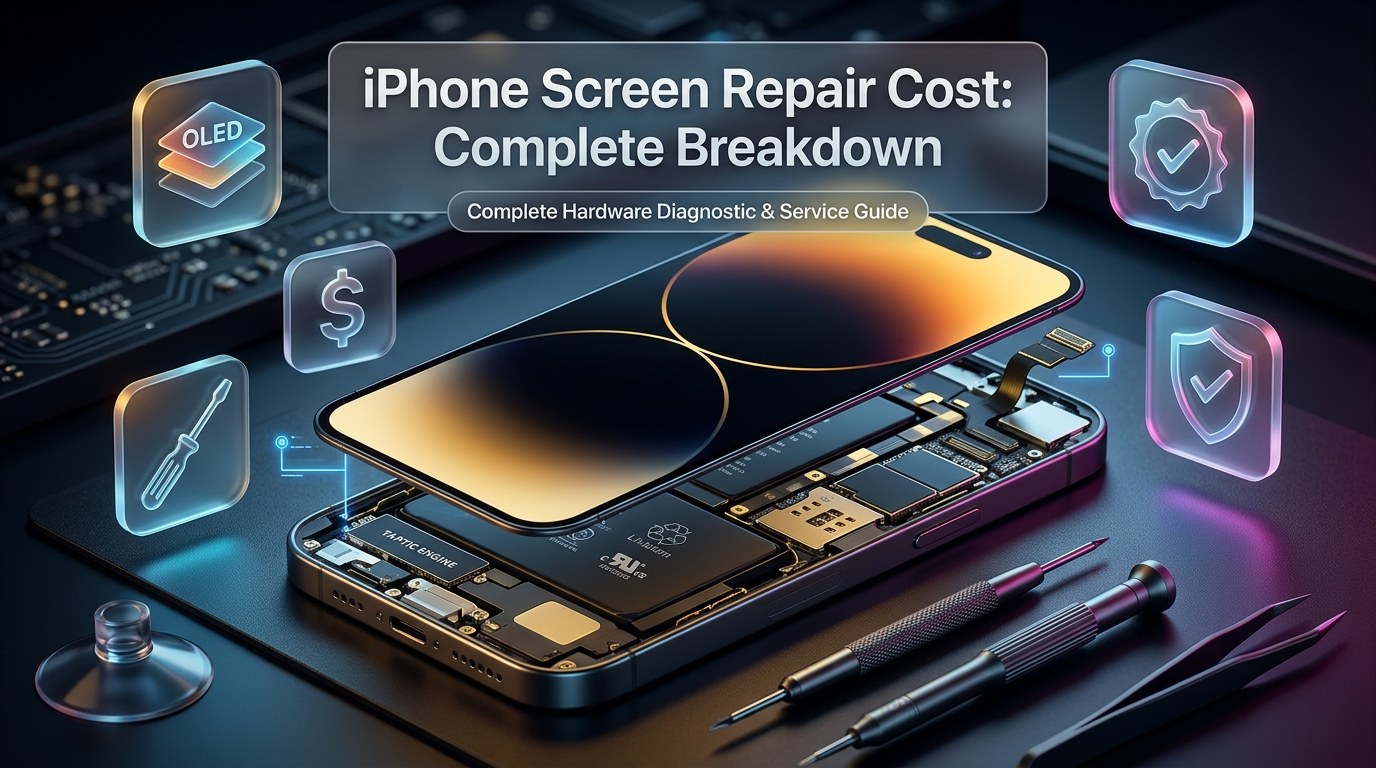
Modern smartphone displays are no longer simple sheets of protective glass placed over a display lamp. An iPhone front panel is a bonded multi-layer electro-optical sandwich combining chemically strengthened Ceramic Shield glass, optically clear adhesive (OCA) polymers, a microscopic capacitive multi-touch digitizer grid, an advanced Super Retina XDR organic light-emitting diode (OLED) or liquid crystal display (LCD) panel, and integrated micro-controller silicon chips. On flagship Pro models, this assembly further incorporates 120Hz ProMotion variable refresh rate circuitry and ultra-thin bezel border routing.
Because screen engineering has advanced dramatically, the cost to repair a damaged screen varies significantly across different iPhone generations, display technologies, and service providers. Replacing the glass on an older LCD-based iPhone SE costs a fraction of replacing an edge-to-edge curved OLED panel on an iPhone 15 Pro Max or iPhone 16 Pro. Furthermore, your choice of service channel—whether you navigate the strict pricing tiers of the Apple Store, seek high-grade same-day service from a certified independent repair center, or attempt an ill-advised do-it-yourself repair—drastically alters the final bill. Navigating these options with a clear technical understanding of parts quality, warranty coverage, and labor expertise ensures you receive maximum value without compromising device longevity or biometric security.
Glass-Only Cracks vs. Inner OLED Matrix Destruction: The Technical Distinction
When assessing a cracked iPhone, device owners often assume that any shattered screen represents the exact same type of damage. In the technical repair industry, however, a critical distinction exists between superficial front glass damage and catastrophic internal display destruction.
The topmost layer of your iPhone screen consists of Apple's proprietary Ceramic Shield (on iPhone 12 and newer models) or dual ion-exchange strengthened glass (on iPhone 11 and earlier models). Directly beneath this glass sits the capacitive touch digitizer grid, followed by the emissive OLED or backlit LCD matrix. If your phone suffers an impact where the glass is heavily fractured but the underlying display continues to show a flawless image—with zero colored lines, no black ink spots, no flickering, and touch response functioning smoothly across every quadrant—your device has sustained glass-only trauma.
Conversely, if the impact penetrates deeper into the display stack, you will witness OLED matrix destruction. Symptoms include bright vertical or horizontal green, pink, or white lines running across the screen; large black blotches resembling spilled ink that slowly expand across the panel; a completely black screen that produces notification vibrations but no image; or erratic ghost touching where the phone opens apps and dials numbers autonomously. In extreme cases, the display will flash blinding white or strobe violently whenever the power button is pressed.
While specialized industrial refurbishing factories possess autoclaves and liquid nitrogen separation machines to slice away shattered glass and laminate new glass onto an intact original OLED, this process is rarely performed inside standard walk-in repair shops due to high failure rates and dust contamination. Certified repair facilities replace the entire unified factory-fused screen assembly—including the glass, digitizer, frame, and OLED matrix. This guarantees factory optical clarity, structural rigidity, water-resistant perimeter seals, and long-term touch reliability.
Service Channel Comparison: Apple Store vs. Independent Repair Shops vs. DIY
When selecting where to bring your damaged handset for screen repair, consumers primarily evaluate three distinct avenues: the Apple Store, certified independent repair facilities, and DIY repair kits. Each channel presents distinct pricing structures, turnaround times, and service trade-offs.
The Apple Store (Out-of-Warranty Fees vs. AppleCare+)
The official Apple Store represents the most recognized service pathway, but it is often the most expensive and time-consuming for customers without an active AppleCare+ subscription. If you purchased AppleCare+ when acquiring your handset and maintain an active monthly or two-year policy, Apple charges a standardized $29 deductible for screen-only damage across all supported iPhone models. However, when factoring in the upfront policy cost—which ranges from $149 to $269 depending on the model—the total investment is substantial.
If your device is out of warranty or you never purchased AppleCare+, Apple's official screen replacement fees climb dramatically. Official out-of-warranty screen replacements at the Apple Store range from $129 for a legacy iPhone SE up to $379 or more for flagship Pro Max models. Beyond the financial cost, official Apple service frequently involves booking appointments days in advance, enduring long wait times at busy retail locations, or surrendering your phone for three to five business days for off-site depot repairs. Furthermore, Apple's strict intake protocols mandate complete factory data erasure if minor frame bending or rear glass cracks are detected, forcing customers to restore backups from cloud storage.
Certified Independent Repair Facilities (Phone Repair Place)
Certified independent repair workshops provide an optimal balance of cost-efficiency, technical expertise, and rapid convenience. At Phone Repair Place in Hyattsville, MD, our technicians specialize in high-precision screen replacement for all iPhone models, typically completing repairs in just 20 to 35 minutes on a walk-in basis without requiring appointments or wiping personal data.
Because independent facilities operate with streamlined overhead and establish direct relationships with premier component manufacturers, pricing is typically 30% to 50% more affordable than Apple's out-of-warranty fees. Furthermore, reputable independent shops offer customers a choice of component tiers: certified original equipment manufacturer (OEM) grade screens or high-quality premium aftermarket Soft OLEDs. Qualified technicians utilize specialized EEPROM programmer hardware to transfer True Tone calibration data and ambient light sensor profiles from your damaged screen to the replacement assembly, ensuring seamless factory display characteristics.
The Real Risks and Hidden Costs of DIY Repair Kits
The allure of ordering a $30 to $50 replacement screen kit from online marketplaces and attempting a weekend DIY repair frequently ends in costly disaster. Online budget screen kits almost universally contain inferior, thick aftermarket LCD copies rather than genuine OLED assemblies. These budget LCDs produce dull washed-out colors, suffer from severe backlight bleed around the edges, draw 40% more battery power from your device, and exhibit sluggish touch response.
Furthermore, the physical disassembly of an iPhone requires micro-mechanical precision. Transferring the delicate upper earpiece speaker and sensor flex cable requires extreme care; this flex cable houses the flood illuminator and ambient light sensor tied directly to Apple's Face ID biometric security system. Prying this ribbon cable with metal tools or tearing it by a fraction of a millimeter permanently destroys Face ID functionality, which cannot be restored by third-party software. Additionally, mixing up the five microscopic screws securing the display shield—a mistake known as "long screw damage"—drives a screw too deeply into the logic board, cutting through multi-layer motherboard circuit traces and rendering the entire phone permanently dead.
Comprehensive Model-by-Model iPhone Screen Repair Cost Breakdown
Display pricing corresponds directly to the underlying display technology and physical dimensions of each iPhone generation. Below is a detailed breakdown of realistic repair costs across major iPhone series.
Legacy LCD iPhone Series (iPhone 7, 8, SE 2nd & 3rd Gen)
These classic models utilize conventional backlit liquid crystal displays (Retina HD LCDs) with physical home buttons. Because LCD technology is mature and inexpensive to manufacture, screen replacements for the iPhone 7, iPhone 8, and iPhone SE (2020 and 2022 editions) represent the most budget-friendly tier, generally ranging from $59 to $89 at independent repair shops compared to $129 to $149 at Apple retail stores.
First-Generation All-Screen OLED & LCD Series (iPhone X, XR, XS, 11 Series)
Apple introduced its first edge-to-edge OLED display with the iPhone X and XS, while offering cost-reduced Liquid Retina LCDs on the iPhone XR and base iPhone 11. Screen replacements on the iPhone XR and iPhone 11 typically cost between $79 and $109. The OLED-equipped iPhone X, XS, and iPhone 11 Pro models require higher-precision panels, with quality Soft OLED replacements typically running between $99 and $139 at independent shops, compared to $199 to $279 through official out-of-warranty Apple service.
Ceramic Shield Super Retina XDR Series (iPhone 12, 13, 14 Base & Plus Models)
Beginning with the iPhone 12 family, Apple transitioned its entire flagship line to Super Retina XDR OLED displays reinforced with Ceramic Shield front glass. These screens feature flat aerospace-grade aluminum edge integration, HDR10 and Dolby Vision support, and peak brightness levels reaching 1200 nits. At independent repair facilities, screen replacement for the iPhone 12, iPhone 13, and iPhone 14 base models generally ranges from $119 to $169 for premium Soft OLED panels, whereas the larger 6.7-inch iPhone 14 Plus runs between $149 and $189. In contrast, Apple's official out-of-warranty pricing for these models sits at $279 to $329.
Dynamic Island & ProMotion 120Hz Series (iPhone 14 Pro, 15 Series, 16 Series)
The pinnacle of Apple display engineering resides in the iPhone 14 Pro, iPhone 15 Pro, and iPhone 16 Pro families. These sophisticated displays feature Low-Temperature Polycrystalline Oxide (LTPO) backplanes supporting 120Hz ProMotion variable refresh rates, Always-On Display capabilities, peak outdoor brightness of 2000 nits, and precise cutout pill geometries for the interactive Dynamic Island. Because LTPO OLED panels are exceptionally complex to produce, replacement assemblies command premium pricing. High-grade OEM-spec replacements at reputable repair centers typically range from $189 to $289 for base models and $249 to $349 for Pro Max flagships, offering substantial savings over Apple's official $329 to $379+ replacement fees.
The Four Display Quality Tiers Explained: OEM vs. Soft OLED vs. Hard OLED vs. LCD
When selecting a replacement screen at an independent repair workshop, understanding the structural differences between parts quality tiers ensures you get the exact performance you expect.
1. Genuine OEM / Original Refurbished Display
An original equipment manufacturer (OEM) or factory-refurbished screen utilizes the exact same OLED substrate, capacitive digitizer, and flex cables manufactured for Apple. This tier delivers 100% factory color calibration, authentic DCI-P3 wide color gamut, peak 2000-nit HDR brightness, instantaneous touch sampling rates, and flawless True Tone compatibility. It represents the gold standard in durability and visual brilliance.
2. Premium Soft OLED (Flexible Substrate)
Soft OLED screens are manufactured on a flexible polyimide plastic substrate, mirroring the physical construction of original Apple factory displays. Because the substrate is flexible, the panel can be bent along the bottom edge inside the housing, resulting in ultra-thin bezels that match original factory dimensions perfectly. Soft OLEDs offer exceptional shock resistance, absorbing drops and impacts without fracturing the display matrix beneath the glass. They deliver 95% to 98% of original color saturation and contrast, making them the preferred premium choice among professional technicians.
3. Hard OLED (Rigid Glass Substrate)
Hard OLED screens utilize a rigid glass substrate rather than a flexible plastic backing. While Hard OLEDs produce excellent deep blacks and vibrant colors characteristic of organic LEDs, their rigid construction means the bottom bezel (the "chin") is often a fraction of a millimeter thicker than original factory specifications. More importantly, rigid glass is inherently brittle; dropping a phone with a Hard OLED screen onto a sharp corner is vastly more likely to fracture the internal OLED layer even if the outer protective glass remains intact. Hard OLEDs represent an economical mid-tier option best suited for budget-conscious owners who keep their devices in sturdy protective cases.
4. Aftermarket In-Cell LCD (Budget Alternative)
Some low-cost repair shops install aftermarket In-Cell LCD panels on iPhone models that originally shipped with OLED screens. While LCDs function, they represent a severe downgrade in every technical metric. LCDs require continuous LED backlights, meaning black pixels glow dark grey, viewing angles are restricted, and overall power consumption jumps by 30% to 40%, rapidly depleting your battery. Furthermore, LCD panels are physically thicker than OLEDs, causing the screen to protrude slightly above the aluminum frame and rendering it highly vulnerable to perimeter chipping. At Phone Repair Place, we advise against installing aftermarket LCDs on OLED-designed iPhones.
The Serialization & iOS "Important Display Message" Transparency
A frequent source of customer confusion regarding modern iPhone repairs is Apple's hardware serialization ecosystem. Beginning with the iPhone 11 family and expanding across subsequent generations, Apple pairs the microchip embedded on the display flex cable directly to the phone's primary logic board during factory assembly.
When a screen replacement is performed outside of Apple's proprietary closed software ecosystem, iOS detects that the unique cryptographic serial number on the replacement display flex does not match the original factory pairing recorded on the motherboard. Consequently, iOS displays an "Important Display Message" notification under Settings > General > About stating: "Unable to verify this iPhone has a genuine Apple display" or "Unknown Part".
It is vital to understand that this notification is purely an informational software prompt. It does not mean your replacement screen is defective, counterfeit, or malfunctioning. The notification appears prominently on your lock screen for four days and inside device settings for fifteen days, after which it permanently retreats into the background battery and hardware history sub-menu. Crucially, your touch functionality, Face ID facial recognition, 120Hz ProMotion refresh rate, and overall display performance remain 100% operational when repaired by skilled technicians who transfer original calibration data using specialized programming hardware.
Comprehensive Comparison Tables: Pricing, Display Tiers, and Repair Methods
To assist in evaluating your repair options, our technical staff has compiled three comprehensive reference matrices detailing model pricing, screen quality differences, and service channel trade-offs.
| iPhone Model Generation | Display Technology | Apple Out-of-Warranty Price | Phone Repair Place Price Range | Average Repair Turnaround |
|---|---|---|---|---|
| iPhone SE (2nd & 3rd Gen) / 8 / 7 | 4.7" Retina HD LCD | $129 – $149 | $59 – $79 | 20 to 25 Minutes |
| iPhone XR / iPhone 11 | 6.1" Liquid Retina LCD | $199 | $79 – $99 | 20 to 30 Minutes |
| iPhone X / XS / XS Max / 11 Pro | Super Retina HD OLED | $279 – $329 | $99 – $139 | 25 to 35 Minutes |
| iPhone 12 / 12 Pro / 13 / 14 | 6.1" Super Retina XDR OLED | $279 – $329 | $119 – $169 | 25 to 35 Minutes |
| iPhone 14 Plus / 15 Plus | 6.7" Super Retina XDR OLED | $329 | $149 – $189 | 25 to 35 Minutes |
| iPhone 13 Pro / 14 Pro / 15 Pro | 6.1" ProMotion 120Hz OLED | $329 – $349 | $189 – $249 | 30 to 40 Minutes |
| iPhone 14 Pro Max / 15 Pro Max / 16 Pro Max | 6.7"–6.9" ProMotion 120Hz OLED | $379 – $399+ | $249 – $349 | 30 to 45 Minutes |
Understanding screen quality tiers enables consumers to select the ideal replacement part tailored to their budget and performance standards.
| Quality Metric | OEM / Original Genuine | Premium Soft OLED | Mid-Tier Hard OLED | Aftermarket In-Cell LCD |
|---|---|---|---|---|
| Substrate Material | Flexible Polyimide Plastic | Flexible Polyimide Plastic | Rigid Glass Substrate | Liquid Crystal Glass Sheet |
| Color Accuracy & Contrast | 100% True Black / DCI-P3 | 95%–98% Factory Color Match | 90%–92% Good Color Depth | Dull / Grey Blacks / Backlight Bleed |
| Bezel Thickness (Chin) | Factory Ultra-Slim | Matches Factory Bezels | Slightly Thicker Bottom Border | Noticeably Thicker Borders |
| Impact Shock Resistance | Exceptional | High (Absorbs shock) | Moderate (Brittle on corner hits) | Low (Prone to glass chipping) |
| Battery Power Drain | Factory Baseline | Factory Baseline | +3% to +5% Power Draw | +30% to +40% Severe Drain |
Evaluating the true cost of DIY repair against professional service reveals the substantial risks of self-repair.
| Repair Vector | Initial Upfront Cost | Required Tooling & Precision | Risk to Face ID / Logic Board | Warranty Protection |
|---|---|---|---|---|
| Phone Repair Place (Certified) | $79 – $249 (Model-Dependent) | Lab-grade heating plates, EEPROM programmer, ESD mats | Zero (Fully certified technicians) | Comprehensive Parts & Labor Warranty |
| Apple Store (Out-of-Warranty) | $199 – $379+ (Very High) | Proprietary Apple robotic calibration fixtures | Zero (Mandates data erase if bent) | 90-Day Apple Warranty |
| Amateur DIY Internet Kit | $35 – $75 (Cheap Parts) | Inexpensive plastic guitar picks, cheap screwdrivers | Extreme: torn Face ID flex, long screw damage | None (Self-inflicted damage voids all claims) |
Hidden Damage Variables That Can Impact Your Final Repair Bill
When calculating the total financial investment required to restore a cracked iPhone, evaluating secondary structural damage is vital. A high-impact drop capable of shattering Ceramic Shield glass frequently transmits kinetic shock waves into adjacent internal hardware sub-assemblies.
The foremost secondary casualty is the aluminum or stainless steel perimeter frame. If an iPhone lands heavily on an acute corner, the chassis metal can bend, dent, or warp inward toward the display cavity. A bent frame creates mechanical pressure points that will pinch a brand-new replacement screen, cracking the brittle glass within hours of installation. Professional repair technicians utilize precision hydraulic corner re-shaping clamps and diamond deburring files to reform bent frame corners before seating a new panel. In severe structural collapses where the entire housing is twisted, a complete chassis transplant may be required.
Water resistance compromises represent another significant variable. Once the front glass or frame adhesive is cracked, environmental moisture, humidity, and raindrops penetrate directly into the interior. If liquid reaches the earpiece speaker mesh or front camera cavity, oxidation begins forming across the Face ID dot projector. Addressing minor liquid ingress during the screen repair process through ultrasonic cleaning prevents delayed motherboard failures and protects your investment.
Post-Repair Display Protection Strategies to Maximize Longevity
Investing in a high-grade screen replacement should always be accompanied by proactive defensive measures to shield your new display from future catastrophic impacts. Modern protective accessories have evolved substantially, offering laboratory-grade energy absorption.
First, install an edge-to-edge tempered glass screen protector boasting an authentic 9H pencil hardness rating and oleophobic fluoropolymer coating. High-quality tempered glass acts as a sacrificial impact barrier. When your handset drops face-down on coarse gravel, the tempered glass absorbs the localized point stress and fractures, safely dissipating the kinetic shock wave before it can penetrate into your underlying Ceramic Shield panel.
Second, select a robust protective case featuring a raised perimeter bezel—commonly referred to as a "lay-on-the-table" lip—measuring at least 1.5mm to 2.0mm above the screen plane. This raised lip ensures that when your phone lands flat on a surface, the impact energy is transferred into the shock-absorbing thermoplastic polyurethane (TPU) bumper rather than the fragile glass surface. Furthermore, cases equipped with reinforced internal air cushions at the four corners dissipate corner impacts that would otherwise shear through OLED matrix edges.
Professional Screen Replacement Sequence at Phone Repair Place
When you entrust your damaged device to Phone Repair Place in Hyattsville, MD, our technical specialists execute a meticulous multi-step restoration protocol engineered to restore factory beauty, structural water resistance, and flawless touch dynamics.
The repair process initiates with comprehensive pre-repair diagnostics. Technicians test multi-touch responsiveness across the entire grid, evaluate the ambient light sensor and proximity sensor, test front and rear cameras, and verify wireless charging coils. The iPhone is then placed onto a precision digital heating separator plate calibrated strictly to 70°C. Controlled thermal application softens the factory water-resistant perimeter adhesive without discoloring OLED crystals or warping internal lithium battery enclosures.
Using calibrated suction clamps and ultra-thin polymer pry shims, our technicians open the display assembly like a book, carefully adhering to Apple's side-hinge opening orientation to prevent tearing delicate display and digitizer data flex cables. The battery connector bracket is immediately removed, and the battery is physically disconnected to cut electrical potential across the logic board. Technicians then disconnect the display, touch, and earpiece flex cables using non-conductive anti-static nylon spudgers.
Next, the damaged screen is connected to our hardware EEPROM programmer. We read the original display serial number, touch configuration matrices, and True Tone optical parameters. These parameters are written directly onto the micro-controller of the brand-new replacement display, ensuring True Tone ambient color adaptation continues functioning seamlessly. The technician then transfers the upper sensor flex under stereo magnification, exercising surgical care around the Face ID infrared optics.
Before final closure, all residual factory adhesive is meticulously scraped from the aluminum frame and sanitized with 99% isopropyl alcohol. A brand-new die-cut waterproof perimeter seal is installed and pressed into the frame. The display is seated and fastened with torque-calibrated pentalobe screws. Finally, the device undergoes a 15-point diagnostic verification test before being returned to the customer—all completed within a 30-minute walk-in visit.
Visit Phone Repair Place for Fast, Affordable iPhone Screen Repair
Do not let a cracked screen, erratic touch response, or distorted OLED lines compromise your daily productivity or risk cutting your fingers on broken glass shards. The experienced technical team at Phone Repair Place in Hyattsville, MD is ready to restore your iPhone to pristine factory condition today with unmatched speed and competitive, transparent pricing.
In addition to our industry-leading certified iPhone repair services, our technicians provide dedicated Samsung phone repair specialists, complete professional Android phone repair services, iPad and tablet repair services, computer and laptop repair solutions, and gaming console HDMI and hardware fixes across our comprehensive electronic repair catalog. Most iPhone screen repairs are completed in just 20 to 35 minutes while you relax or shop inside The Mall at Prince Georges. Every replacement screen is backed by our dedicated warranty covering parts and labor. Walk-ins are warmly welcomed daily, or contact our workshop directly for a free immediate quote.
Phone Repair Place
3500 East-West Hwy STE 1417,
Hyattsville, MD 20782, United States
(202) 870-4914
https://phonerepairpgmall.com/
Frequently Asked Questions
What is the average iPhone screen repair cost at Phone Repair Place?
Depending on your specific iPhone model and chosen display quality tier, screen replacement at Phone Repair Place typically ranges from $59 to $89 for legacy LCD models, $99 to $169 for standard OLED flagships, and $189 to $289 for advanced 120Hz ProMotion Pro Max models. Our pricing is typically 30% to 50% more affordable than Apple Store out-of-warranty fees while including fast same-day walk-in turnaround.
Will replacing my iPhone screen cause me to lose my data or photos?
No, standard screen replacement does not affect your device storage, apps, photos, or personal data. Unlike Apple retail locations that often mandate complete factory wipes during hardware check-in, our technicians replace only the physical display assembly, leaving your data 100% intact.
Will my Face ID still work properly after getting a new screen?
Yes, your Face ID facial recognition biometric security will continue working perfectly when the repair is performed by certified technicians. Our specialists carefully transfer the original earpiece sensor flex cable containing Apple's paired flood illuminator and infrared hardware to the new screen assembly without damage.
How long does an in-store iPhone screen repair take at Phone Repair Place?
Most iPhone screen repairs are completed in just 20 to 35 minutes at our Hyattsville, MD workshop inside The Mall at Prince Georges. We maintain a large inventory of premium replacement screens on site, allowing walk-in customers to have their device repaired and fully tested in a single brief visit.
What does the "Important Display Message" in iOS settings mean?
On iPhone 11 and newer models, Apple pairs the factory screen flex serial number to the motherboard, causing iOS to display an informational message stating it cannot verify the display if replaced outside Apple's closed network. This notice is purely informational; it does not impair your touch responsiveness, display quality, or Face ID functionality in any way.
Need This Problem Fixed Fast?
Bring your broken smartphone, tablet, or console to Phone Repair Place in Hyattsville, MD for quick diagnosis and same-day turnaround.